The risk to nonprofits is not AI adoption. The risk is unmanaged AI adoption.
Updated October 2026: Johanny Torrico developed this model in April 2026.
Community IT President and COO Johanny Torrico created this framework to help nonprofit leaders move from informal, unstructured AI use toward intentional, mission-aligned adoption. It’s short and designed for executives and board members.
Executive summary
Artificial intelligence is already present in nonprofit work. It is appearing in draft grant proposals, donor communications, and internal knowledge management, often through informal use by staff members. While these tools offer a path to increased productivity, using them without a clear strategy creates unnecessary vulnerabilities for the organization.
At Community IT, we believe that implementing AI is an operational decision, not just a technical one. For many leaders, the primary challenge is not finding the right tools, but integrating them into daily operations in a way that is secure and mission-aligned.
The nonprofit reality
Nonprofit organizations operate under constant constraints, including funding volatility, limited staffing, administrative burdens, and increasing cybersecurity risks.
AI has the potential to improve productivity across key functions, including grant writing, donor communication, board reporting, case documentation, and knowledge management.
However, unstructured adoption introduces real risks: exposure of sensitive data, inaccurate outputs, overreliance without validation, and inconsistent usage across staff.
As a result, AI should not be treated as a short-term experiment, but as a core workforce capability requiring intentional development, clear boundaries, and structured adoption.
Why AI adoption is an operational decision
Implementing AI in nonprofits is not just a technology decision; it is an operational decision. Effective adoption requires alignment across security and data protection, operational workflows, and staff capability and training.
Many organizations struggle more with integrating tools responsibly into daily operations than with selecting the right ones. This framework is designed to help nonprofit organizations move from informal AI use to structured, mission-aligned adoption.
The Mission-Aligned AI Adoption Model
Nonprofit organizations benefit most from a structured approach to AI adoption, one that balances opportunity with risk, and innovation with mission alignment. This model outlines a practical path for moving from informal, unstructured use of AI to intentional, governed, and integrated adoption.
- Stage 1: AI Literacy & Guardrails. Build foundational understanding, define boundaries, and establish safe usage.
- Stage 2: Mission-Aligned Use Cases. Identify and prioritize AI applications that directly support mission delivery.
- Stage 3: Operational Integration. Embed AI into workflows with governance, oversight, and continuous improvement.
These stages are not purely sequential. Organizations may revisit earlier stages as their AI use evolves. However, strong outcomes depend on building a solid foundation.
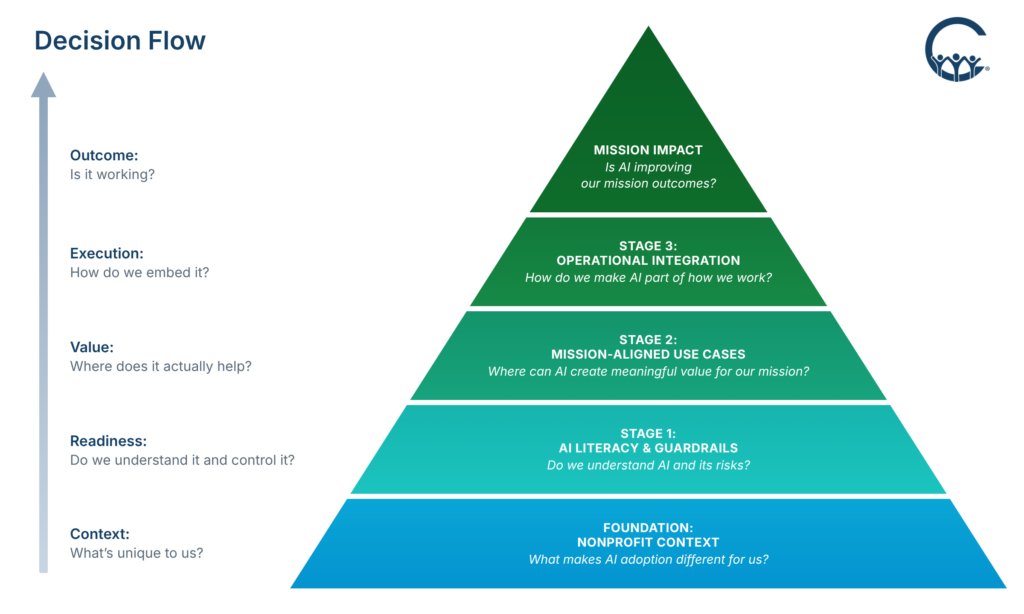
This foundation reflects the operating realities of nonprofit organizations. Decisions on AI adoption must be guided by mission priorities, constrained resources, and heightened security and compliance needs. Unlike other sectors, nonprofits cannot pursue broad experimentation without clear purpose and boundaries.
As a result, each stage of this model should be interpreted through this context, ensuring that AI is applied in ways that strengthen mission delivery, protect sensitive information, and make effective use of limited staff capacity.
Stage 1: AI Literacy & Guardrails
Without a clear understanding, AI poses significant risks. Improving AI literacy enhances organizational capability and helps prevent unintended outcomes. The initial phase of AI adoption centers on establishing a basic understanding throughout the organization and setting clear boundaries for its use.
Without this foundation, adopting AI can cause more harm than good. This phase isn’t about deploying tools; it’s about making sure leadership and staff understand what AI is, how it should be used, and where its use needs to be restricted. The key components of this stage include:
Executive and board alignment
Leadership must establish a shared understanding of AI’s role within the organization, including how it supports mission delivery and the organization’s risk tolerance.
Staff AI literacy (foundational skills)
Staff should develop baseline capability to understand AI tools, identify appropriate use cases, and apply basic prompting and evaluation techniques.
Clear AI usage boundaries
Organizations must define what is permitted and what is not, particularly regarding sensitive data, donor information, and internal content.
Data classification review
Existing data policies should be reviewed to determine what information can and cannot be used within AI tools, ensuring alignment with privacy and compliance requirements.
Initial guardrails through policy and governance
Establish interim guidelines that define approved tools, require human oversight, and set expectations for responsible use.
Stage 2: Mission-Aligned Use Cases
Once a foundation of AI literacy and guardrails is established, organizations can begin identifying and implementing AI in ways that directly support mission delivery.
This stage focuses on moving from general awareness to practical application, ensuring that AI is used intentionally to improve how work gets done, rather than for experimentation alone. The goal is not to deploy AI broadly, but to apply it selectively in areas where it can create meaningful impact while maintaining appropriate oversight. The key components of this stage include:
Identify workflows aligned with mission priorities
Focus on time-intensive workflows that directly support mission outcomes, such as grant writing, donor communication, reporting, and program documentation.
Establish clear purpose for each use case
Define what success looks like before implementation. Each use case should have a clear objective: will it reduce time, improve quality, or increase consistency?
Prioritize based on impact and risk
Evaluate potential use cases based on expected return (time savings, quality improvement, capacity gain) and associated risks (data sensitivity, accuracy requirements).
Pilot targeted implementations
Test a small number of prioritized use cases in controlled environments. Avoid broad rollout until effectiveness and risks are better understood.
Measure outcomes and learn
Track results such as time saved, improvements in output quality, and increased staff capacity. Use findings to refine your approach and inform broader adoption.
Stage 3: Operational Integration
As AI usage expands, organizations must move from isolated pilots to consistent, organization-wide practices. This stage focuses on embedding AI into daily workflows while maintaining appropriate oversight, accountability, and risk management.
The objective is to ensure that AI use is not dependent on individual experimentation but is integrated into how work is performed: consistently, securely, and in alignment with organizational standards. The key components of this stage include:
Formalize AI usage policy
Build on the interim guidelines established in Stage 1 to update, approve, and formalize an AI usage policy. The policy should define acceptable use, data-handling standards, approved tools, and expectations for human oversight, and can be incorporated into the organization’s existing acceptable use policy.
Embed AI into operational workflows
Integrate AI into standard processes and tools so that usage becomes consistent and repeatable, rather than ad hoc.
Establish ongoing monitoring and review
Regularly evaluate AI usage, including effectiveness, risks, and alignment with organizational goals. Adjust policies and practices as needed.
Continue workforce development
Expand AI literacy beyond foundational skills, ensuring staff continue to build capability as tools and use cases evolve.
Conclusion
Community IT knows that nonprofits have the entrepreneurial spirit to pursue AI capabilities in support of their missions; we also know that it is not a simple task to embrace and integrate a brand-new technology throughout your organizational operations and strategy. We are here to help.
Keep exploring
- AI Acceptable Use Policy template: a starting point for the guardrails in Stage 1.
- Download a printable PDF of the model to share
Author:

Johanny Torrico brings over thirty years of experience managing teams and operations to her role as President and Chief Operating Officer at Community IT, where she leads the largest internal team providing services to clients. A calm and organized leader, Johanny is responsible for the service and technical operations for all the teams at Community IT. She also leads staff development and internal business processes, with a focus on staff retention and career mentoring.
As Chief Operating Officer, Johanny played a critical role in leading the dramatic expansion of our service operations. She established new teams, expanded company management and led the successful adoption of a wide range of new technologies. Johanny has a special ability to promote standardization of our services in ways that add value for our clients. Johanny brings decades of experience, professional maturity and tremendous skillsets as a business leader.
During her tenure at Community IT, Johanny has mastered every role she has taken on including network administrator, network engineer, and service manager. She still enjoys providing technical support to our clients, participating in our professional services team, and implementing technical solutions. She draws on her long experience interacting with nonprofit clients in various roles to understand how best to partner with our community.
Prior to joining Community IT, Johanny served as Director of Technology for The National Association of People with AIDS (NAPWA) for nearly four years. Previously, she worked for 11 years at Whole Foods Market, where she was the Facility Leader for their food plant in Landover. Through these management experiences Johanny gained extensive leadership, planning, management, and customer service skills.
Johanny holds a B.S. in Computer Information Systems. She is a VMWare Certified Professional and a Microsoft Certified IT Professional for Office 365.
Is Your IT Partner Meeting the Moment?
As your organization navigates challenges, you deserve a support team that is as committed to your mission as you are.
Would you like to see how our human-centered approach can stabilize your IT environment? If you have questions about how to align your technology with your mission, we are here to help.
Community IT has been serving nonprofits exclusively for 25 years. We offer Managed IT support services designed for organizations that want a partner, not just a provider. For a fixed monthly fee, we provide the proactive planning and ongoing IT strategy you need to ensure your technology is always an asset and opportunity, not a liability.
We think your IT partner should be able to explain everything clearly, without talking down to you or using unnecessary lingo. If you’re ready to gain peace of mind and clarity about your IT roadmap in our challenging environment, let’s talk.
As advocates for using technology to work smarter, we’re practicing what we recommend. This article was drafted with the assistance of AI, but the content was reviewed, edited, and finalized by a human editor to ensure accuracy and relevance.
This is one piece of a larger picture. Explore our AI for Nonprofits guide for the full context.
Photo by Aaron Santelices on Unsplash